What is data?
- Data is an increasingly big part of our lives
- Lots of data is stored by government and business
- Anything written or spoken may also be classed as data
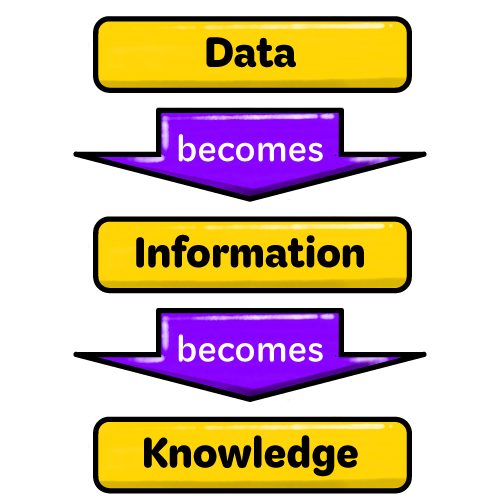
Data on its own is meaningless.
It only becomes useful when we process it.
At this point, it becomes information.
Information = data + [structure] + [context] + meaning
Data may not always need structure and context to become information, but it often does.
-
Example of Data
Information = data + [structure] + [context] + meaning
• Raw data: 55, 72, 88, 49, 95
• Raw data is unprocessed facts and figures that have no meaning on their own
-
Example of Adding Structure
Information = data + [structure] + [context] + meaning
Adding structure organises the data:
• Student A: 55
• Student B: 72
• Student C: 88
• Student D: 49
• Student E: 95
-
Example of Adding Context
Information = data + [structure] + [context] + meaning
Adding structure organises the data:
• Student A: 55 marks (out of 100) in the Maths test
• Student B: 72 marks (out of 100) in the Maths test
• Student C: 88 marks (out of 100) in the Maths test
• Student D: 49 marks (out of 100) in the Maths test
• Student E: 95 marks (out of 100) in the Maths test
-
Example of Adding Meaning
Information = data + [structure] + [context] + meaning
Adding meaning allows us to interpret the results
• The pass mark is 50. Students A and D failed, while B, C and E passed.
• Student E had the highest score (95).
• The class average score was 71.8.
-
Using Information
Information = data + [structure] + [context] + meaning
We now have information which we can use to make decisions, such as…
• Which students need extra support?
• Do topics need to be revisited?
• Should some students move to a different set?
-
Knowledge
Now we have information, and have made our decisions, we have knowledge!