
The Purpose of the CPU
The CPU can be thought of as the computer's brain. It:
- Receives instructions and data from input and storage devices
- Controls everything the computer does
- Sends the results of processing to output and storage devices
All computing devices have a CPU.
The Fetch–Decode–Execute Cycle
-

Fetch
The CPU fetches an instruction from the computer's RAM (like getting a command from a to-do list).

Decode
The instruction is then passed to decode.
The CPU decodes the instruction. This means it figures out what the instruction is telling it to do and converts it into instructions which can be carried-out.

Execute
The decoded instructions are passed to execute.
The CPU executes the instruction – it does what the instruction says.

Repeat
The processed data is now passed back to RAM to be stored.
Because this is a cycle, it starts all over again.
Remember, CPUs are super-fast, and they can do billions of these cycles every second!
Factors Affecting CPU Performance
Clock Speed

- CPUs can only perform one instruction at a time
- On each tick of its clock, it performs one Fetch-Decode-Execute cycle
- Clock speed is measured in cycles per second (hertz)
- Modern CPUs can execute billions of instructions per second (gigahertz)
- Hertz is shortened to Hz, megahertz to MHz, and gigahertz to GHz.
Number of Cores

- A CPU core can be thought of as an extra processor within the CPU
- Each core has its own fetch-decode-execute cycle which runs at the same time as the other cores
- This lets the whole CPU process more than one instruction at a time
- Dual core means two cores, quad core means four cores, and octa core means eight cores
CPU Cache
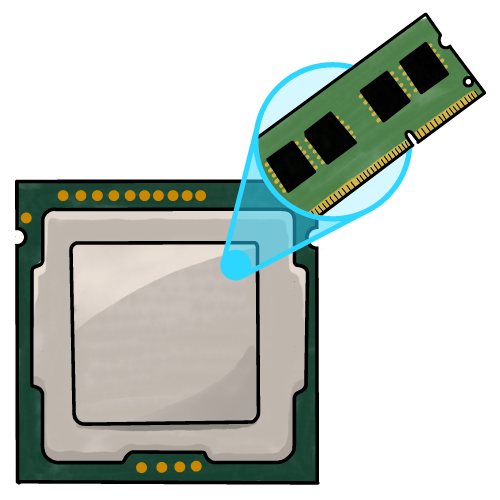
- An area of super-fast memory on the CPU
- Frequently used instructions are kept in the cache — it’s quicker than getting them from RAM
- Cache memory is small and very expensive
- Do not confuse CPU cache with web browser cache. CPU cache only stores data for the CPU, browser cache stores web page data
Calculating Instructions Per Second
To calculate how many instructions per second a CPU can perform, we multiply the clock speed by the number of cores.
Example: A 4GHz CPU with two cores will execute 8 billion instructions per second
(4GHz is 4 billion instructions, multiplied by 2 cores, equals 8 billion instructions per second).